The Wire Chair

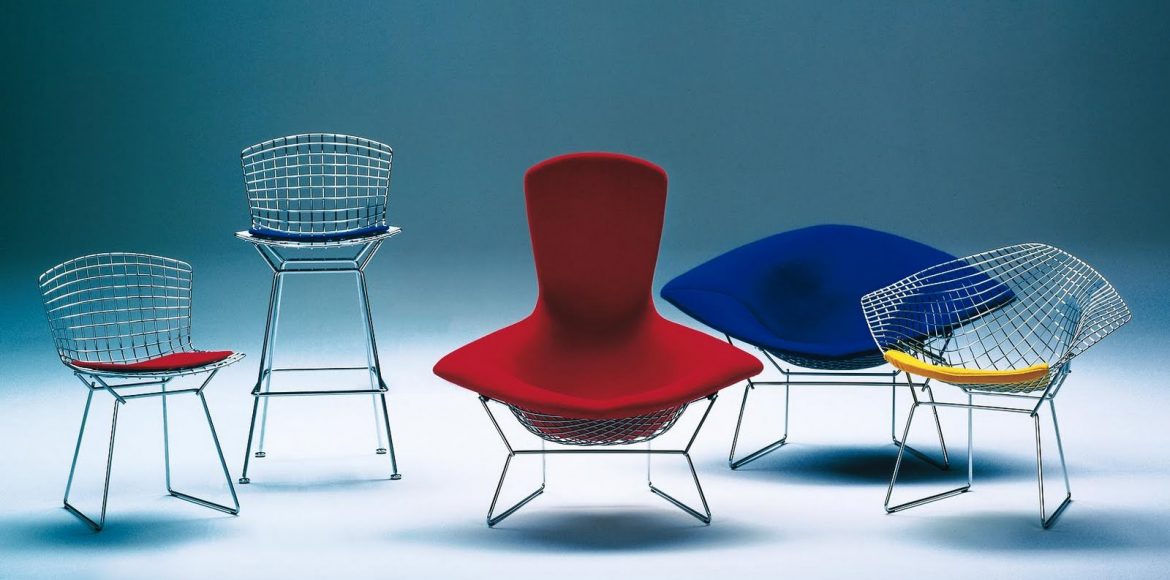
The birth of the wire chair’s popularity can easily be traced back to Charles and Ray Eames’s wire side chair released in 1951. This iconic object for everyday use fit right along with their fundamental principle for its use of new material. Wire rods were by no means new material in that era although their use as a structure for seating certainly was. As is the case when it comes to iconic forerunners, this simple side chair was not the only one of its kind. Beyond this side chair by the dynamic Eames duo, Harry Bertoia’s 420 side chair is just about the only iconic wire chair recognizable by name to the modern enthusiast.

A designer, engineer or architect has much to think about when concocting a chair from this rigid, yet flexible material. The chair needs to hold up to the weight of the average human body, needs to to be functional as a chair (subsequently, a chair’s many uses), all the while maintaining its shape – must we add it should be comfortable? Designer’s like Russel Woodard, Verner Panton and Harry Bertoia have produced real-life visions that embody all of these aspects and often is the case a cushion is needed to address the matter of comfort.

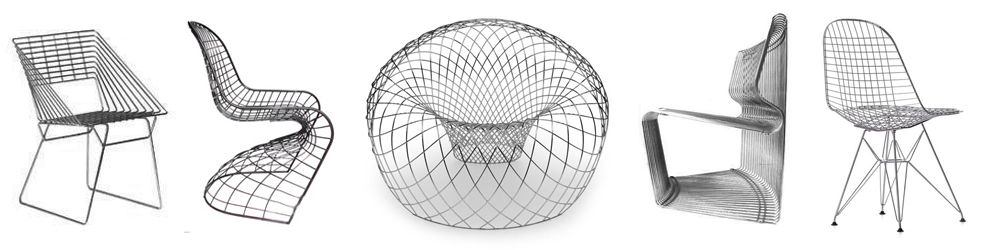
The contemporary wire chair of today knows only the limit of a designers computer software and the available funds to produce the project. Take Verner Panton’s iconic plastic cantilever chair – a first in its field for being molded from a single mold of plastic, virtually indestructible for daily use and naturally produced in its bold colors. Now, from a CAD computer program’s wireframe rendering those curvaceous lines and shapes of this plastic chair can be produced through the process of meticulously bending each rod of chrome-laden wire to intersect just right – mirroring the chair itself. It is any wonder how the Bertoia and Eames chairs of their day were executed without the aid of a computer. Contemporary masterminds such as Brodie Neill blew the minds of furniture and design lovers in 2011 with the release of his Reverb chair. This spherical vortex of wire mesh reminds one of  a theoretical wormhole – have a seat in the center and take a load off!

For collectors

Reproduction of a Harry Bertoia Side Chair – click to view detail

Wire chairs are hard to make. Production costs can easily outweigh the benefits of selling at an affordable price. Therefore it is usual that the best of the best (and easiest to produce) designs are sent to the open market. Chairs by Warren Planter, Verner Panton and most contemporary designs are a safe bet as far as authenticity are concerned. Chairs by Charles and Ray Eames and by Harry Bertoia don’t have that luxury. To some imitation is the best form of flattery, so it is left to the consumer to decide whether or not to buy authentic or to buy a reproduction. For the most popular Harry Bertoia side and diamond chairs, take a look at their main outermost structural elements. You’ll notice that on the originals there is one wire holding together the structure with the mesh of structural wired welded to this one. Now, take a look at an inexpensive knock-off. The eye instantly sees the two wires holding the structure together around the entire chair and back of the seat. These pieces of lesser quality are designed in this fashion to allow a manufacturer to use a thin gauge of wire – not as Harry Bertoia had originally planned.
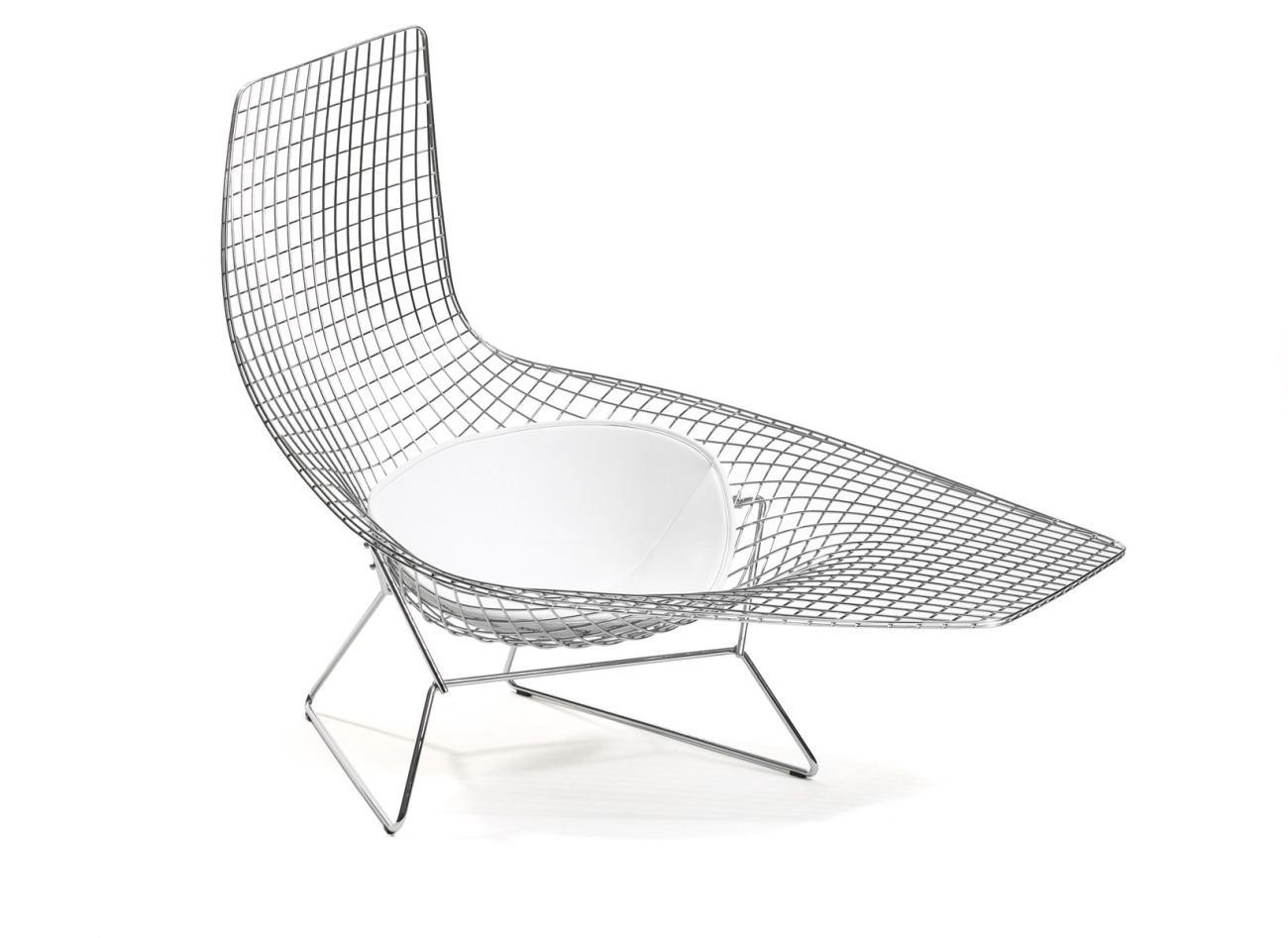
The Pantanova and Planter chairs – as with the more complex designs – are usually out of reach for the beginning consumer. A Pantanova Chaise can run between 4000-7500USD with the wormhole-like Reverb chair (created in a very limited production) costing 25,000USD. Our best bets are to find the chair (or chairs) you love and research! Then, stalk! Original Bertoia and Eames wire side chairs can be found at your local mid-century dealer in the 175-400USD range. As always, check the web and eBay. If you miss out on a bargain, never fear, there will always be another chance as millions were produced for the global market. On the higher end if you find what suits you best, never be afraid to ask a dealer if they can come down on the price. Even the most high end of dealers will consider a slight discount if they know they will receive a certain sale. Whatever your choice you’ll find that a wire chair will bring a unique linear openness to your space – making these useful structural objects a great addition.
Klasema Collection of Modern Art

The Klasema ART abstract Modern Art collection covers a unique selection of prominent early European, North America and Russian Modernist artists, painters and sculptors. Driven by passion for beauty and quality, these (geometric) abstract Modern artworks have been carefully collected over the past forty years, with a special focus on abstract Modern artworks from the influential post-war period (1945–1976).

klasema Art Collection - the netherlands

Klasema Art Collection – The Netherlands

Stumbling upon the Klasema Art Collection is like stumbling upon a treasure trove – an encyclopedia of modernist art. All abstract and predominately geometric in nature, the collection as a whole is fascinating and inspiring in its vision. Yet, surprisingly, Klasema ART remains accessible and educational in its overall approach.

I found Klasema in my young and eager searches for inspiration and in my hunt for adding to my own collection of geometric abstraction. Searches for Joost Baljeu, Jean Gorin and Silvano Bozzolini kept leading to the same place.

At first apprehensive to make first contact and inquire I found the site an exceptional source of knowledge. I am happy that I did. You see, I am in the United States – Klasema, the Netherlands. Although fond of early American geometric abstraction my tastes and curiosities have grown to European works which inspired (and were inspired by) the same vein of mostly non-representational art. Our esthetic tastes are very well aligned with painting and sculpture dominating the collection.

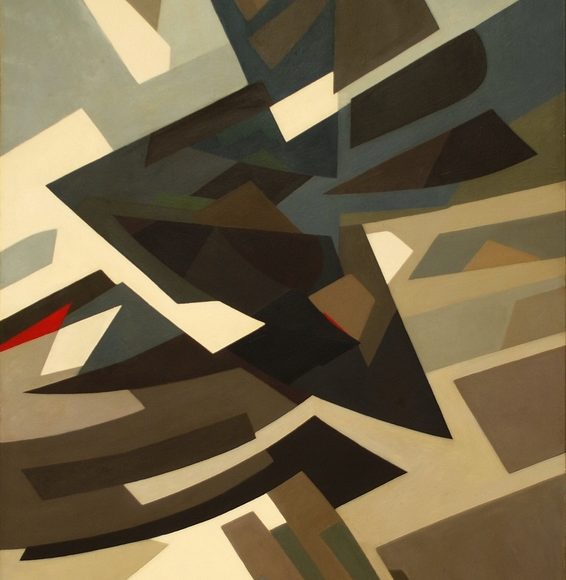
Helen Gerardia, 1951

Helen Gerardia, 1951

I would have never realized that the people I’d make contact with at Klasema were so very open and approachable – not to mention as passionate. Almost like a close friends I’ve known for years whom I just so happen to have never met. Not yet anyway. Equally open to a question from a young artist or from a seasoned collector interested in their next acquisition.

Original founder Henk Klasema had little by way of serious connection to art in his youth, but always, an appreciation stood very close by. As he matured and became successful in his business endeavors his appreciation exploded into a life-ling passion. Much like a collapsing celestial being his passion’s gravity soon caught hold of his immeadeate family.

Unexpectedly, Henk Klasema passed away in 2011, now the collection and its private museum-like grounds are continued by his wife Anneke Klasema van Loenhout, who stood at his side for forty years and is as passionate an knowledgeable about Abstract Modernism and the artists in the KLasema ART collection.

As is usually the case with any serious art collector the family made friends with the artists, acquiring bodies of work that often span their careers. This collection often exhibits the nuances and changes within several of their artists works over a span of time. As the collection grew the family started acting as both collector and dealer of these works by placing important works into other collections and publishing multiple books and catalogs.

Follow and learn more from Klasema on Facebook.

Visit the Klasema ART – Collection of Modern Art  online. I like that each piece is accompanied by a description and information about the artist/creator.

A few questions

…with the collection’s director Anneke Klasema

CI: All of the work represented is abstract and geometric in nature. Some is very tight and what one thinks of as hard-edge geometric abstraction (Jean Gorin for example) – and some work is very loose, bordering on abstract expressionist (Hendrik van Bottenburg and Willy Boers). Can you give us some insight into how the collection has evolved to include this mix of esthetic over time?

(AK): As do most Artists, we started out with an interest in high quality figurative art. Names like Gino Severini, Isaac Israels, Reimond Kimpe, Hendrik Willem Mesdag and Max Peiffer Watenphul were part of our early collection . We however changed gradually into acquiring more and more early Modern abstract artworks. As my husband once put it ‘Abstract art is very personal and touching. For me, the feeling of equilibrium and beauty is important. Exaggeration of colour and composition must be avoided. In my opinion an artist should always focus on the heart of the matter and should try to keep things as simple as possible’.

CI: If you and your family were to choose one or two works in your current collection that could be considered a quintessential work which piece would it be? What about this work makes it such a great representation of the collection?

(AK): This is always a difficult question. This is a very personal thing. Different people have different tastes. But for me the works that have very special meaning and can be considered quintessential to our collection are the Joseph Lacasse (1952), Nicolas Warb (1945), Dolf Breetvelt (1950) and the Walter Helbig (1932). These works are all absolute masterpieces by the artists. The use of colour and composition, the quality and uniqueness. Over the years my husband Henk and I have always focused on collecting top quality art, and these works are just that.

Memphis Milano: The Dennis Zanone Collection

Dennis Zanone’s Malabar Room with Various Memphis Collections

The Memphis group comprised of designers and architects (mainly Italians) who created a series of influential products in the 1980’s. They challenged the idea that products had to follow conventional shapes, colors, textures and patterns. Expensive elements such as granite and marble were paired with materials such as plastics, plywood, laminates and Formica. Often was the case that color and pattern were saturated beyond many observer’s level of comfort. Form followed function – or did it?

The Memphis group was founded in 1981 by Ettore Sottsass who called Memphis design the ‘New International Style’. Among its members were Alessandro Mendini, Martine Bedin, Andrea Branzi, Aldo Cibic, Michele de Lucchi, Nathalie du Pasquier, Michael Graves, Hans Hollein, Arata Isozaki, Shiro Kuramata, Matteo Thun, Javier Mariscal, George Sowden, and Marco Zanini

Certainly ground breaking at the time, the creations – which ranged from small housewares to entire buildings – were a stark contrast to the chrome-laden black and brown leather creations stemming from the much earlier Bauhaus School and mid 20th century modernism. They took this approach to the “redefinition of design” and soon began exhibiting clocks, lighting, furniture and ceramics created by internationally famous architects and designers.

The work of the Memphis Group has been described as vibrant, eccentric and ornamental. Art Deco, Pop Art, and Futurism were some design inspirations although the work coming out of their group were certainly unique creations.

Sottsass dismantled the group in 1988 and although Memphis may no longer exist it has certainly influenced many and designers in all fields to this day.

The Memphis Milano collection of Dennis Zanone

Dennis Zanone is a photographer and avid Memphis Milano collector living in Memphis, Tennessee. With over 20 years of investment it would be harder to believe that any individual (or museum) has a larger and more comprehensive Memphis Milano collection – even though the likes of MOMA and even Karl Lagerfield  have/had also caught the Memphis bug. We are very fortunate that Zanone meticulously documents and shares the pieces on his Memphis Milano Flickr stream and shares the love and knowledge via his Memphis Milano Facebook Page.

Ethan Stern – Contemporary Glass Artist

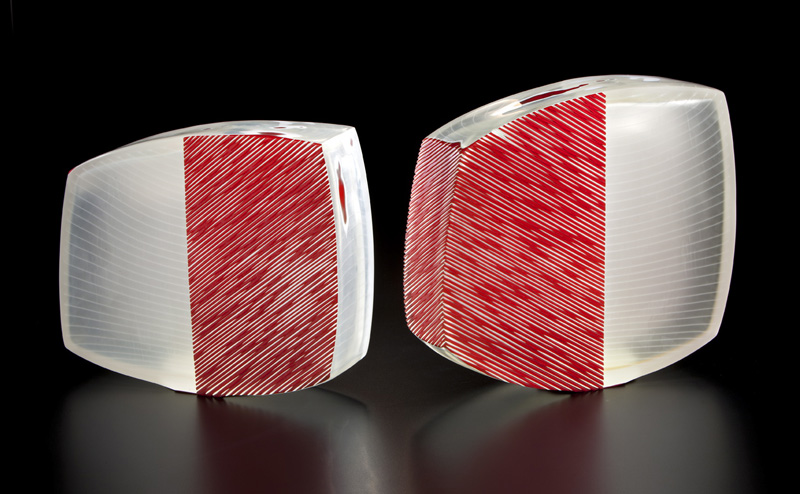
Drop Duo by Ethan Stern, 2011

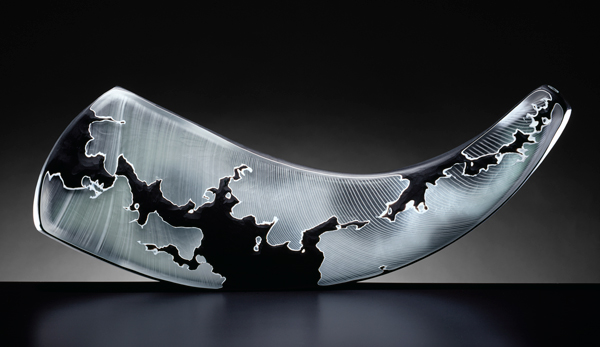
Glass is not a forgiving material. It demands an involved process and requires careful planning and manipulation. As the most direct way for Ethan Stern to leave his mark, engraving has become his voice within the medium. The process of carving is a reductive one; material cannot be added once it is removed. This action of continuously revealing layers adds a significant amount of weight to each step and the choices made, allowing the process to play the ultimate role in defining the relationship between the surface and form of each piece

“At the most basic level, my work is an ongoing exploration of abstraction and the expressive qualities of form, color, texture and light. I use glass as a catalyst to help answer questions about how we see our environment, the objects we use everyday and the spaces we occupy. I am very aware of how my physical surroundings influence the qualities of each piece. I live in an urban area and work in an industrial part of Seattle. I cannot help but allow the hue of the day and the contrast between the engineered and natural landscapes permeate my sense of beauty. Translating this information into my recent work has led to imagery and form inspired by design, architecture and the visual deconstruction of my surroundings.

In the past, my formal investigation has been limited to shapes that are flattened and sculpted to have geometric edges and tight corners creating a strong silhouette. I have been drawn to this way of working not only as a means to explore pure form, clean lines and minimal composition, but to create a canvas for texture and pattern on the surface. While these forms have allowed for a significant amount of exploration, I have become interested in a more direct investigation of the role architecture plays in my artistic practice and the human interaction with physical surroundings.”

Stern’s newest work attempts to examine how objects on a human scale can be viewed as architectural. How much does scale influence our interpretation of beauty and perfection? Drawing from the idea that architecture can be more than a building, more than a large square structure which functions before it speaks, Stern feels challenged to investigate how we relate to the objects we live with. Can balance and contour dictate how we interact with the materials around us? If standing in front of a building hovering above you feels imposing, what happens when its form has no right angles or tilts and curves like the human form? Through blown glass objects reflective of these architectural forms, Stern investigates how our urban environments directly influence our human experience, while allowing the work and process to interact with the public in new and exciting ways.

Ethan Stern lives and works in Seattle, WA. where he operates Diamond Life Studio. You may learn more and view works at www.ethanstern.com. Ethan will exhibit new works at the Hawk Gallery in Columbus, OH on March 31st 2012.

Invisible Designers in Contemporary Art Glass

 By Matthew Cummings

Sam Stang, Greg Fidler, Michael Schunke, Katherine Grey, Boyd Seguki and Lisa Zerkowitz….If you are a fan of design – especially of contemporary art glass – you probably haven’t heard of these names. If these names are indeed foreign to you then I am sure you will be pleasantly surprised with the quality and originality of these contemporary American Glass Designers/Craftsmen. The Studio Glass Movement began in 1962 at the Toledo Musuem of Glass in Ohio. It was a workshop thrown together by Harvey Littleton and Dominic Labino that changed the face of glass production. As Americans have no true lineage in glass, we had to learn first through trial and error. Then we pushed forward by absorbing the techniques and approaches from other countries long-standing glass traditions, such as the Czech Republic, Italy, German, and England.

This set the tone for globalization in the Studio Glass Movement (a predominantly American movement) long before the world became flat again through the digital mediums. In contemporary glass design, we can still see the aftereffects of this journey towards material forefathers in the aesthetics and decorative techniques. The selection of work that I have chosen includes pieces influenced by Northern European Ceramics, and Italian Glass, both specifically from mid century designers.

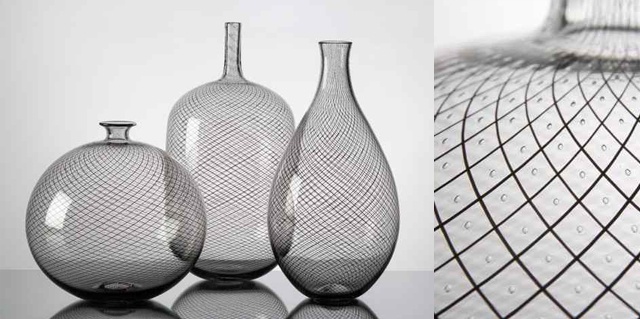
The craftsmen influenced by ceramics are given the opportunity of translating the stunning work of Carl Harry Stahlhane, Stig Lindberg, and Meindert Zaalberg into glass and utilizing the inherent qualities of the material to find new shapes. The highest gloss possible in ceramics is easily surpassed by the natural finish of glass and bulbous forms are quickly created by the introduction of the craftsman’s breath in the vessel. The designers influenced by the Italian tradition find themselves in a wonderfully interesting dialogue between American and Italian Glass. The tradition that so heavily influenced the development of the Studio Glass Movement now finds itself surpassed by the creativity/ingenuity of the young american movement (within this context).

The Venetian Golden Age is generally considered to have occurred between 1930-1960 with a plethora of quality designers working on the island of Murano. Most importantly, the glass company Venini inviting designers from other backgrounds to work at the factory. Since the Venetian Golden Age, the level of creativity has slightly dwindled with the exception of a few individual maestros… Lino Tagliapietra, Livio Seguso, Davide Salvedore, ect. In the 1990s, Seattle passed Murano as the epicenter of glass design and sculpture. While some of the glass shown here is influenced by the Italian Glass tradition, it could actually be considered the most viable steward of that lineage.


Explore further

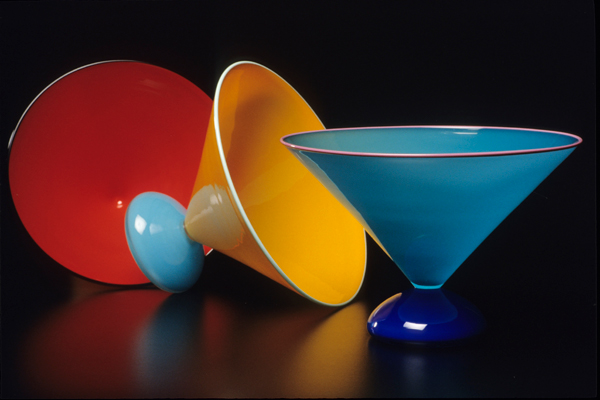
Two Tone Studio is the production studio of glass craftsmen Boyd Seguki and Lisa Zerkowitz. This husband and wife team blend contemporary design and everyday utility. Their series of cocktail-specific vessel sets are wonderful in their response to the each cocktail in terms of color, functionality, and traditional vessel shape. Two Tone Studio is located outside of Seattle and both Boyd and Liza graduated from the Rhode Island School of Design.

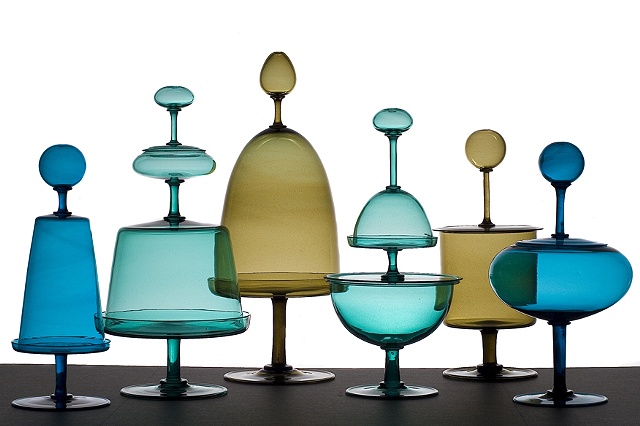
Ipso Facto Studio was founded by Greg Fidler and Brent Cole. The glass is currently produced by Greg at his studio in Bakersville, NC. The Form Studies are beautiful novellas of mid-century Swedish ceramic designs. They come in a variety of colors and each form is unique.

IBEX was founded by Sam Stang, David Levi, and Dimitri Michaelides in St. Louis and operated from 1985-1991. This powerhouse glass company produced designs that have been copied and distributed throughout the country.

You can find a selection of their designs at Vetri Gallery in Seattle.

After IBEX dissolved, Sam Stang began producing his own unique and production glass vessels. His work showcases a mastery of Venetian techniques applied to modernist forms. He now works out of Augusta, MO with his wife Kaeko Maehata.

Michael Schunke’s limited edition designs, marketed under Nine Irons Design, are shown throughout the country and produced in his West Grove, PA studio. He is one of the world’s preeminent goblet makers.

http://www.nineironstudios.com/

Katherine Grey is a contemporary glass artist who also produces some incredible functional designs that often fit neatly inside of each other. Katherine is the only craftsperson on the list that doesn’t run a production studio, but I love the work so much that it demanded to be included.